
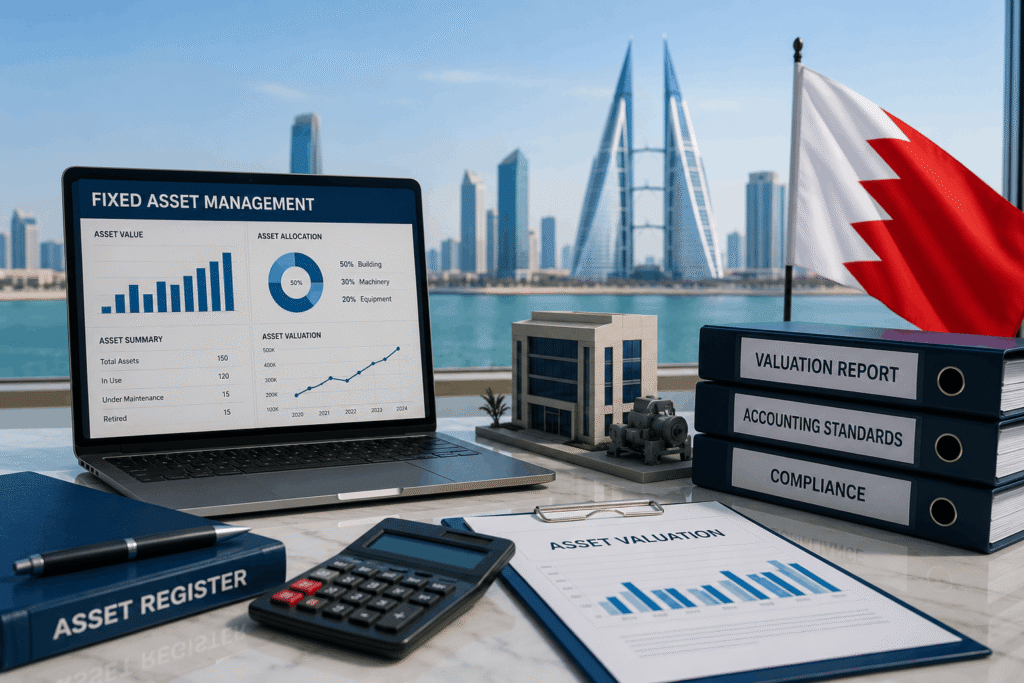
Fixed assets like machinery, equipment, and buildings are crucial for businesses. Effective management requires careful recording, monitoring, depreciation, and reporting to ensure financial accuracy and compliance. In Bahrain, an accurate fixed asset register is vital for financial integrity. This guide underscores the importance of sound fixed asset management and suggests best practices for businesses.
Fixed asset management is the process of tracking and accounting for long-term assets across their lifecycle, which includes recording purchases, monitoring their condition, calculating depreciation, managing repairs, tracking transfers, and documenting disposals. An effective asset management system ensures that financial records correctly represent the assets owned by the business.
IMPORTANCE OF PRECISE DEPRECIATION
Depreciation is the gradual decrease in an asset’s value over its useful life, allowing businesses to allocate its cost over several accounting periods instead of recognizing it all at once. Accurate depreciation is crucial as it has a direct impact on financial reports. Precise depreciation affects:
Reliable & Correct Profit figures in balance sheets.
Tax Compliance Computation
Future capital investment plans and unexpected replacement costs.
- Credibility with banks, investors, and auditors.
Depreciation and fixed asset management
Fixed asset management system records: Asset acquisition date, Purchase & Installation cost, Useful life, Depreciation method, Residual & Current book value, accumulated depreciation, Asset location and Custodian details
When these records remain current, depreciation calculations become consistent, transparent, and audit-ready.
Why is Asset Tracking Vital ?
- Ghost assets( Disposed/written off /replaced/ undocumented) mislead financials, inflate values, and complicate asset management processes.
- Correct asset valuations enhance the integrity of financial reports and the fixed asset register.
- Systematic records decrease audit duration and enhance adherence.
- Companies can predict future replacement expenses more accurately.
- Depreciation schedules aid in accurate budgeting for capital expenses.
- Adequate documentation assists in IFRS reporting and readies companies for changing tax laws.
Strategies for Efficient Fixed Asset Management
- Keep a comprehensive fixed asset ledger.
- Document each acquisition, transfer, and disposal without delay.
- Conduct regular verification of physical assets.
- Abolish ghost assets by conducting frequent reconciliations.
- Periodically assess useful lives and residual values.
- Guarantee appropriate record-keeping for auditing needs.
- Utilize suitable depreciation techniques consistently.
- Utilize automated asset management tools.
Accurate depreciation relies on effective fixed asset management. By maintaining accurate asset records, conducting regular verification, and implementing structured asset tracking, businesses can improve financial reporting, strengthen compliance, and make informed business decisions. For organizations in Bahrain, investing in a robust fixed asset management system is a strategic step toward ensuring accurate asset valuation, reliable financial management, and sustainable long-term growth.
ERUM Accounting Services and Consultancy W.L.L is among the Best Accounting Firms in Bahrain, offering comprehensive accounting, taxation, finance, and business consulting solutions. As experienced Accounting Consultants in Bahrain, the firm provides accounting, bookkeeping, CFO services, payroll management, financial reporting, VAT Registration Services Bahrain, and VAT Return Filing Bahrain to support compliance and business growth.
ERUM also specializes in Business Setup in Bahrain, Company Registration Services Bahrain, Corporate Restructuring Services Bahrain, Financial Planning and Budgeting Bahrain, Business Advisory Services Bahrain, and Audit Support Services Bahrain, delivering reliable and value-driven solutions that help businesses achieve sustainable success.